Elevate Your Pitch: Mastering the Oscar Presentation
Walking into a boardroom or jumping onto a Zoom call with a potential client brings a specific kind of pressure. You have the data, the strategy, and the service, but if your visual aids look disjointed or cluttered, you risk losing credibility before you even finish your introduction. Convincing a prospective partner is never just about the numbers; it is about how you frame them. When you hand over a presentation that feels disjointed, it implies your business operations might be the same. Conversely, a seamless, well-structured deck acts as a silent advocate for your professionalism. This is where the Oscar Professional Business Presentation steps in, specifically designed to bridge the gap between your raw ideas and a polished, persuasive narrative.
The Psychology of Magenta in Corporate Design
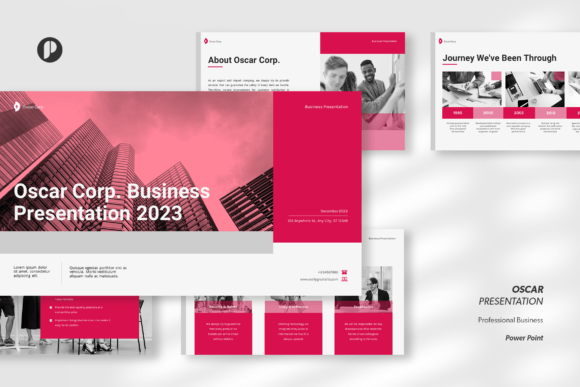
Many business owners default to safe blues and greys when building their brand assets. While there is nothing wrong with tradition, it often leads to a sea of sameness where your pitch blends into the background. The Oscar Professional Business Presentation takes a calculated risk with its primary color palette. Magenta is a hue that commands attention without the aggression of a pure red or the frivolity of neon pink. In color psychology, magenta is often associated with harmony, emotional balance, and creative practicality. For a brand identity or a pitch deck, this is a powerful psychological lever. It signals that your company is innovative and forward-thinking, yet grounded enough to handle serious business.
However, strong color choices require a disciplined layout to remain effective. If the design is too loud, the audience focuses on the graphics rather than the content. The genius of the Oscar template lies in its restraint. It utilizes a clean and neat look that anchors the vibrant magenta. By employing white space and light grey backgrounds, the template creates a visual hierarchy that guides the viewer’s eye naturally. Black text pops against these lighter backgrounds, ensuring that your typography remains the hero of the story. This balance is crucial for modern typography and layout design. It proves that you understand the principles of contrast and readability, reinforcing the idea that you are a detail-oriented professional.
Structuring Your Narrative for Maximum Impact
A presentation is essentially a visual story. If the chapters are out of order or the pacing is off, the story fails to land. One of the most common pitfalls in editorial design and slide creation is the lack of a consistent grid. The Oscar template solves this by providing a well-organized layout system. Whether you are creating a company profile or a project offer, the structure is already there to support you. You do not have to guess where to place an image or how much margin to leave on the side. This consistency across 15 unique designs ensures that your flow is logical. You move from the problem statement to the solution, then to the financials and the timeline, without visual interruptions.
This organized approach does more than just look good; it aids in information retention. When a prospective partner reviews your deck after the meeting, they will be able to scan the slides easily because the layout is predictable and professional. This is a key component of visual hierarchy. By keeping the layout standard, you allow the content to vary. You can feature full-bleed images for emotional impact on one slide, and data-heavy charts on the next, all while maintaining the same design DNA. This versatility makes the Oscar template suitable for various industries, from tech startups seeking venture capital to creative agencies pitching for a new retainer.
Practical Application and Customization
While the structure is fixed to ensure quality, the content must be fluid to fit your specific needs. The Oscar Professional Business Presentation comes in both PPT and PPTX formats, ensuring compatibility with the software you already use. The ability to edit text, images, and colors is standard, but the value lies in how the template handles these edits. Because the design is clean, it is incredibly forgiving when you swap out placeholder text for your own copy. You do not need to be a graphic designer to make it look custom-made. The design assets are structured so that even if you change the magenta accent to a deep navy or a corporate teal, the visual hierarchy remains intact.
Consider the specific use cases for your business. If you are a marketer creating a social media graphics report or a quarterly review, the data visualization placeholders allow you to drop in charts without breaking the slide. If you are an entrepreneur working on a business proposal, the text blocks are sized to accommodate enough detail without becoming a "wall of text." This is a common struggle in presentation design—trying to say too much on one slide. The Oscar layout encourages brevity and impact. It forces you to distill your message down to its most potent elements, which is a valuable exercise for any business strategy.
Beyond the Boardroom
While the name suggests a corporate environment, the utility of a premium font and layout system extends far beyond internal meetings. Think about how you present your brand identity to the public. A well-designed presentation can be repurposed. You can export slides as images for your website’s "About Us" section or use them as high-quality visuals for LinkedIn posts. The Oscar Professional Business Presentation is designed with this multi-channel mindset. The aesthetic is timeless enough to work for a formal investment pitch but modern enough to look at home on a digital portfolio.
For small business owners and content creators, this template serves as a foundation for building a visual language. If you consistently use the layout and color schemes provided, you begin to train your audience to recognize your style. This consistency builds trust. When a client sees that you have taken the time to prepare a professional business presentation that looks distinct and well-crafted, they subconsciously elevate their perception of your service value. It shifts the conversation from "how much does this cost" to "how much value can this bring." In the competitive landscape of business development, that shift in perception is often the deciding factor in closing the deal.